

Testing for free iron, now available at SESL’s laboratory
SESL Australia’s inhouse laboratory has recently added the analysis of free iron (Fe) oxide to its testing suite, which can be used to determine if a soil is a Ferrosol (containing a free iron oxide content >5% Fe).
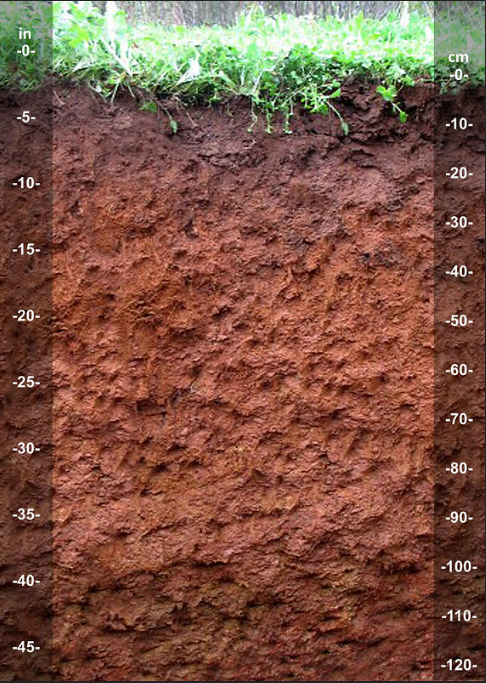
Free iron oxide refers to ‘pedogenic iron’ which is formed through weathering of ferrous-containing volcanic basalt, which is also responsible for the deep red and brown shades that we see in Ferrosol soils. Ferrosols are particularly prominent across Australia’s eastern coast, Tasmania, the Top End and northern parts of Western Australia.
Free iron content is determined in the laboratory by using a citrate-dithionite extract (method by Rayment and Lyons 2011, Method 13C1). This is because citrate-dithionite chemically reacts with secondary crystalline iron oxides such as hematite, goethite, lepidocrocite and maghemite) and poorly crystalline amorphous minerals (excluding magnetite and ilmenite).

Red Ferrosol profile from Red Hill, VIC.
Source: Agriculture Victoria
Characterisation of iron oxide minerology in Australian soils is currently lacking, and this analysis can help with understanding soil variability across geographical areas, and facilitate the effective management of agricultural land. Ferrosols are deep and well drained, particularly in high rainfall zones, and prone to acidification, erosion and compaction which may be exacerbated by cropping practices. Land uses include pasture, plantation forestry, horticultural crops and cattle grazing. (shallow soil areas).
Pipers River catchment, North East
TAS. Source: Tasmania DPIPWE &
University of Tasmania


Comments